

How to Take a Seat at the Table: Power Strategies for Women in Startups
It's no secret that the startup industry is a boys' club, but that doesn't mean women entrepreneurs don't have a place at the table. There are plenty of powerful strategies that women can use to make sure their voices are heard and respected in the startup world. Let's take a look at some of those strategies.
Get a Seat at the Table: Power Strategies for Women in Startups - Discuss how to get funding, be heard, advance your startup so that you and every female has a seat at the business table.
You've probably heard the saying, "you can't be what you can't see." This is especially true for girls and young women who are looking to enter a male-dominated field like startups. In order to achieve parity in these industries, we need more women in positions of power. So how do we get there? Amie speaks to power strategies that women can use to show up in the startup world and get the funding and success they deserve.
You might think to yourself, “well, all entrepreneurs and founders struggle; it’s an uphill battle to be heard.” You might, if steeped in Girlboss media encouragement (which is great, don’t get me wrong!) even find it kind of problematic to suggest that it’s still harder for us than it should be to achieve these goals. After all, there are more women in C-suites (and in the venture capital space) than ever before, right?
That’s right. But it often is harder, and if you want to succeed, it’s important to understand why this is the case.
Women struggle when it comes to obtaining capital because we’re a smaller group and still, sadly, subject to various forms of documented bias.
But there are things we can do to create opportunities. These include being aware of the landscape, building strong personal and professional networks, and finally, growing our power by bolstering our own confidence in ourselves and in our vision.
The Startup Landscape for Women
We all know women who have successfully launched awesome businesses, from celebrities like Rihanna who obviously have a major leg up in the funding department, to those we might know personally with big ideas who’ve also found an astounding measure of success, but though women own almost 40% of the businesses in America, less than 2% of LP-VC funding goes to women fund managers, and less than 2% of VC investments go to women founders(TechCrunch). All Raise has found that although more women became VC partners over the past few years than ever before, 65% of US-based venture capital firms still do not have any female partners. This affects our access to funding, because there are additional hurdles in the way, including the first pitch to investors.
Researchers studying the way venture capitalists pose questions to fledgling founders revealed obvious bias; a majority of the queries aimed at men wanted to know how they’d grow their businesses and about related future goals, but most of the questions for women tested their competence and asked about how much they’re currently doing in-house, focusing on viability rather than vision. Of course, all of these are key elements that VCs would be wise to consider, but it’s telling that the emphasis was so different depending on the entrepreneur’s gender.
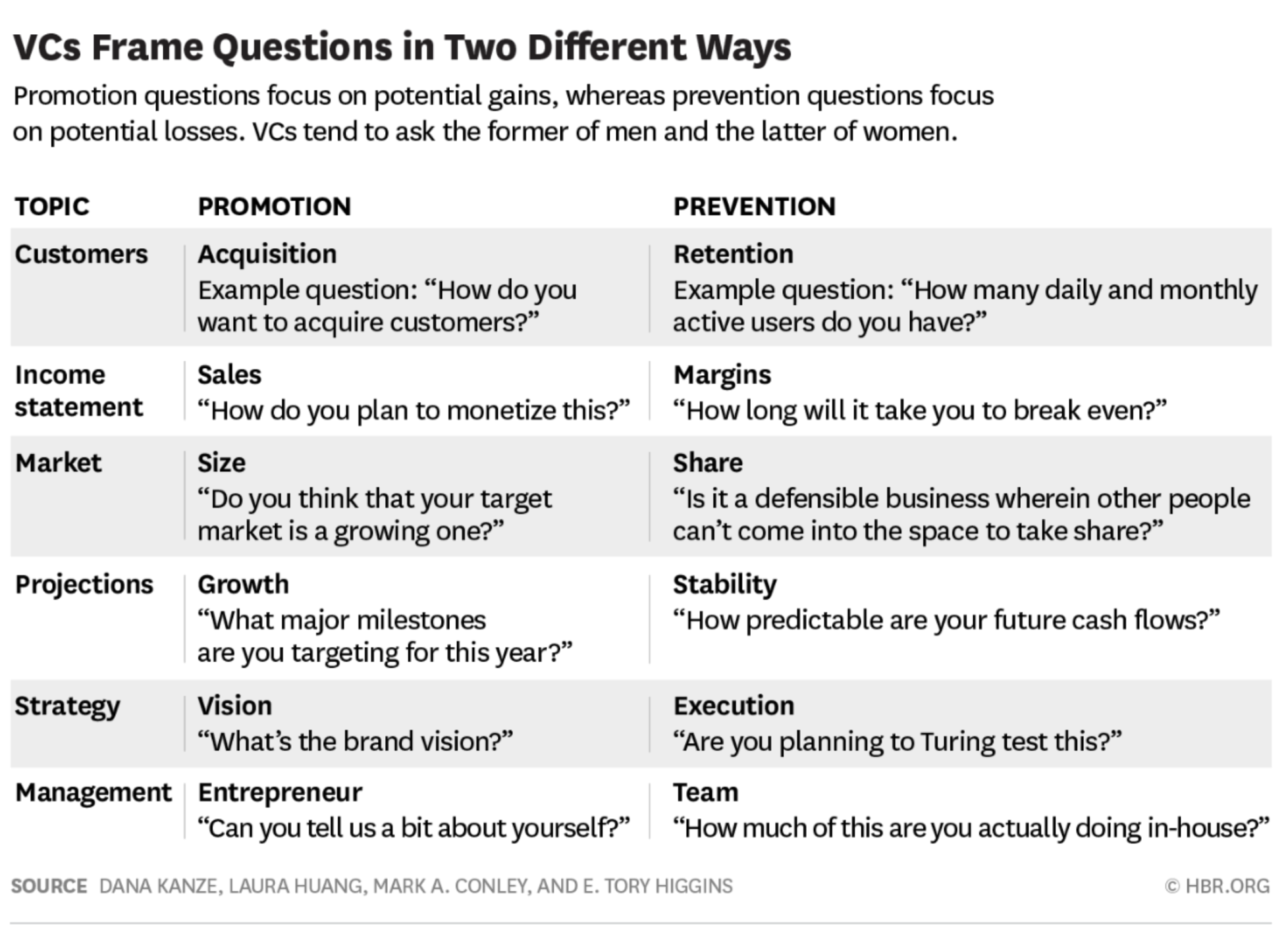
There are funds just for us though, right? Yes, and that’s great! There are incubators and VC projects aimed at women in the entrepreneur space, but unfortunately, they receive more publicity than money, and they don’t have the same institutional influence of the larger firms out there.
So, what about those female VCs? You might be surprised to learn that if you do raise first-round funding from one of the small number of female investors (who also control less money), it could negatively impact your ability to successfully raise a second round. A study of 200 MBA students and investors found apparent bias in the way female founders are appraised based on receiving funding from other women, and this bias was even apparent from female investors! The study concluded that businesses that received backing from gender-diverse investor teams received better capital funding in later rounds.
As a female entrepreneur, it can be more difficult to secure backing due to bias in the system. However, there are steps you can take to build a stronger rapport with venture capitalists and increase your chances of receiving the funding you need.
You should be able to articulate your plan clearly and back it up with hard data. Showing that you have done your research and understand the market will help build trust with potential investors. Additionally, having an understanding of the VC’s goals and expectations will help you tailor your pitch accordingly.
Building a supportive network
Networking is everything: the people you know are among your most valuable resources. You don’t already have a network? Well, you can’t create a company and career in a vacuum.
We have difficulties in building our networks, despite the perception that women are naturally good at being social and because of the way things have “always been done.” Many investors and potential mentors will admit that they choose people to work with because they move in similar environments and have friends and hobbies in common; that’s a challenge when you don’t smoke cigars and hit the links, but times have changed.
Make sure you are actively engaging with other entrepreneurs, investors, and industry professionals who can help you reach your goals. Connect with possible mentors via social media and offer them help/volunteer to assist them in building connections as well. (Twitter is one of the best ways to find startup resources, connections and follow VC leaders.)
This will boost your visibility in the industry and give you an opportunity to present yourself as an expert in your field.
How do you find inspiring people to connect with? Start by looking for resources in your local area or virtual opportunities. (I was fortunate to get involved with a local accelerator in Austin). There are a handful of great incubators and accelerators for female entrepreneurs offering support and community around the country, including NewMe, AlphaLab in Pittsburgh, and The Brandery in Cincinnati. Organizations like these (and others designed to reach every new entrepreneur regardless of gender) can be a great benefit to you in meeting other motivated founders, and immersing yourself in their expertise and creating connections to help you build growth capital. Pounding the pavement and networking at industry conferences or startup events. Yes, most of the big ones are worth getting on the jet plane and making a trek to meet, introduce yourself, and build those networking relationships you need now.
What else can you do? Be proactive in asking advice from the mentors and sponsors you meet. Seek out powerful female role models and observe how they cultivate “executive presence” – bold, trustworthy, and confident.
And as you learn, pay it back, and be the change you want to see. Provide advice and share resources with others. There’s room for all of us to succeed. And by the way, talented women are more likely to want to work with you as your business grows if you pursue diverse relationships and hire women from the jump; they won’t see your startup as another boys’ club.
Boost your power
We’re not talking about “girl power” or “power for the sake of power,” but the concept of building your power in the context of starting a business can be daunting, and part of this is conditioning that you might not even be aware of.
You might be afraid of being seen a certain way; as a go-getting striver instead of as a person who “great things just happen to.” You might be wary of risk in an uncertain economy and changing world. You might be reluctant to grab the brass ring.
But you have to learn to work through these fears and grow your power by asking for what you want and need. If something can help to make your business successful—ask for it! This could mean requesting tips from other entrepreneurs or negotiating with VCs or partners on the terms of a deal. If you’re able to confidently ask for what you want, you’ll prove that you’re serious about success and not afraid of taking risks or pushing boundaries when you need to.
Confidence is key to building power when it comes to getting ahead in any field, but especially in the startup environment where competition is extra, extra fierce. Don't wait for someone else to bring up your idea or take credit for it; be assertive and make sure your voice is heard. People will take notice when you demonstrate confidence—in yourself, your ideas, and your work—and they'll be more likely to listen to what you have to say.
Beat back the fear! Fearless female entrepreneurs know how to recognize opportunities and act on them quickly. Don’t let fear stand in your way—understand that failure is part of success and view it as part of the journey rather than a setback. Even if something doesn't work out as planned, t use that information to adjust your approach and try something new instead of giving up entirely.
As veteran comic Joan Rivers once said, about making her way in an industry dominated by men, “If I can't make it through one door, I'll go through another door—or I'll make a door.”
Power is also based on respect, which isn't given; it must be earned. As a woman in the startup space, you can command respect from day one by presenting yourself professionally and confidently whenever possible—in meetings, emails, conferences, etc.—and always remember that you’re equal to anyone else in the room regardless of gender or experience level.
Having a seat at the table is essential for business success as an entrepreneur; especially if you're a woman trying to break into heavily male-dominated industries like tech and startups, Being aware of the challenges that we face in today’s startup landscape, networking effectively, and believing in yourself and having confidence in your ideas should all be a part of your power strategy.